Defensible space is the single most effective factor in whether a structure survives a wildfire. Research from the National Fire Protection Association (NFPA) and the Colorado State Forest Service (CSFS) consistently shows that homes and commercial buildings with properly maintained defensible space are significantly more likely to survive wildfire than those without it. For Colorado property owners, especially in Douglas County and the foothills communities west of Denver, fire mitigation is not optional -- it is a core property management responsibility.
Colorado's Growing Wildfire Risk
Colorado's wildfire environment has changed dramatically over the past two decades. The combination of extended drought, bark beetle damage to ponderosa and lodgepole pine forests, and continued development in the wildland-urban interface (WUI) has created conditions where catastrophic fire events are increasingly common.
The Marshall Fire in December 2021 destroyed 1,084 homes and damaged 149 others in Boulder County, making it the most destructive wildfire in Colorado history. What made the Marshall Fire particularly significant for property managers is that it spread through grassland and suburban development, not through deep forest. Wind-driven grass fires can move at speeds exceeding 40 mph, outpacing evacuation in some cases.
According to the CSFS, approximately 2.4 million Coloradans live in the WUI, the zone where development meets wildland vegetation. Douglas County's growth along the foothills corridor has placed thousands of homes and commercial properties in fire-prone terrain. The county's combination of ponderosa pine, scrub oak, and dry grassland creates fuel conditions that support both crown fires and fast-moving surface fires.
The Three-Zone Defensible Space Framework
The CSFS and the Firewise USA program (administered by the NFPA) define defensible space using three concentric zones around a structure. Each zone has specific vegetation management requirements. The zones are measured from the outermost point of the building, including attached decks, porches, and fences.
Zone 1: 0 to 15 Feet -- The Immediate Zone
Zone 1 is the most critical area for structure protection. The goal is to create a non-combustible buffer directly around the building. Specific requirements include:
- Remove all dead vegetation, dry leaves, pine needles, and woody debris from the ground surface, gutters, and roof.
- Use non-combustible hardscaping (gravel, stone, concrete pavers) for pathways and ground cover immediately adjacent to the structure.
- Eliminate any vegetation that overhangs the roofline. Trim tree branches to maintain a minimum of 10 feet of clearance from the structure and chimney.
- Move firewood stacks, propane tanks, and other combustible materials outside of Zone 1.
- Ensure that window screens are intact and made of metal mesh, not fiberglass, which melts in radiant heat.
- Use fire-resistant mulch (rock or gravel) rather than wood bark mulch within 5 feet of the structure. Wood mulch ignites readily from windblown embers.
The CSFS estimates that 90% of homes lost to wildfire in Colorado are ignited by windblown embers landing on or near the structure, not by direct flame contact. Zone 1 management targets this specific ignition pathway.
Zone 2: 15 to 100 Feet -- The Intermediate Zone
Zone 2 is where most vegetation management work occurs. The objective is to reduce fire intensity and slow the rate of spread so that the fire approaching the structure is a lower-intensity surface fire rather than a high-intensity crown fire. Key practices include:
- Thin trees to maintain a minimum of 10 feet of spacing between crowns (the leafy/needle canopy). Spacing should increase on slopes because fire moves faster uphill.
- Remove all ladder fuels -- the low-growing vegetation, dead branches, and small trees that allow fire to climb from the ground into tree canopies. Prune tree branches to at least 6 to 10 feet above ground level.
- Create fuel breaks using mowed areas, gravel paths, driveways, or irrigated landscape beds that interrupt the continuity of combustible vegetation.
- Remove dead standing trees (snags), dead shrubs, and heavy accumulations of fallen branches.
- Mow native grasses to 4 inches or less during fire season (typically June through October in the Denver Metro and foothills area).
On properties with slopes, the CSFS recommends extending Zone 2 beyond 100 feet on the downhill side of the structure because fire travels faster and with greater intensity uphill.
Zone 3: 100 to 200 Feet -- The Extended Zone
Zone 3 applies primarily to properties on larger lots or those adjacent to open space and wildland areas. The goal is to disrupt fire continuity at the landscape scale. This zone does not require removing all vegetation but focuses on reducing density and eliminating concentrations of dead material.
- Thin tree stands to reduce overall density. The specific spacing depends on tree species, slope, and aspect (south- and west-facing slopes dry out faster and carry fire more readily).
- Remove dead trees and heavy accumulations of dead and down material.
- Create mosaic patterns of thinned and unthinned areas to break up fuel continuity.
- Where possible, connect property-level defensible space with community-level fuel breaks and shaded fuel breaks along roads and evacuation routes.
Vegetation Management Techniques
Effective fire mitigation requires species-specific knowledge and proper equipment. The following techniques are used in professional fire mitigation work in the Colorado Front Range and foothills.
Selective Thinning
Selective thinning removes smaller, suppressed trees while retaining larger, healthier specimens. In ponderosa pine forests, this mimics the natural fire regime that historically maintained open, park-like stands. The CSFS recommends retaining trees with the largest diameters and best crown vigor, as these are the most fire-resistant individuals.
Limbing and Pruning
Removing lower branches to a height of 6 to 10 feet eliminates ladder fuels that allow surface fire to transition into crown fire. On steep slopes, higher limbing is necessary because the effective flame height increases with slope angle.
Brush and Scrub Oak Management
Gambel oak (scrub oak) is one of the most common and most flammable shrub species in Douglas County and the foothills. Dense stands of scrub oak carry fire rapidly and resist control efforts. Management options include mastication (mechanical grinding), hand cutting, and prescribed burning where permitted. Complete removal is not always necessary or desirable; thinning to reduce density and create separation between clumps is often sufficient.
Slash Management
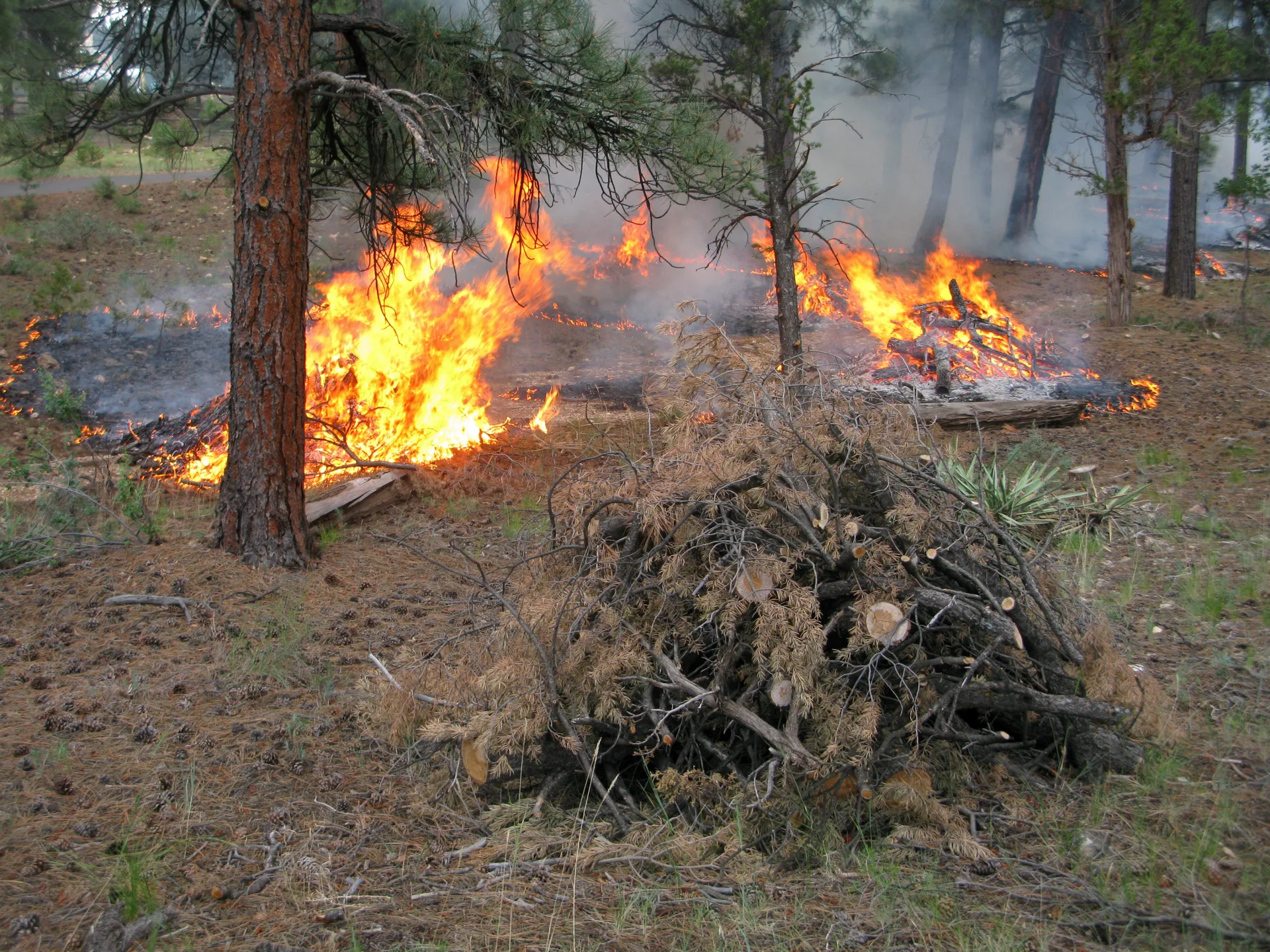
Vegetation removed during thinning and pruning (slash) must be disposed of properly. Options include chipping on-site with a commercial chipper, hauling to a designated slash disposal site, or piling and burning during permitted burn windows. Douglas County and many Front Range communities operate seasonal slash drop-off sites where residents and contractors can dispose of material at no cost.
Douglas County: Specific Risk Factors
Douglas County's fire risk profile is shaped by several converging factors that make fire mitigation especially important for property owners in the area.
- Pine beetle damage. Mountain pine beetle infestations have killed millions of acres of lodgepole and ponderosa pine across Colorado over the past two decades. Dead trees are significantly more flammable than living trees, and beetle-killed stands produce intense fire behavior. Properties bordering beetle-affected areas face elevated risk even if their own landscaping is maintained.
- Drought conditions. The Denver Metro area and Douglas County experience periodic drought that reduces moisture content in live vegetation. During drought years, even irrigated landscapes adjacent to dry native areas face increased fire risk from wind-driven ember transport.
- Population growth in fire-prone terrain. Douglas County's population grew from approximately 175,000 in 2000 to over 370,000 by 2024, with much of that growth occurring in communities along the I-25 corridor and in the foothills. New development in areas with dense vegetation and limited road access creates evacuation challenges and increases the number of structures at risk.
- Red flag conditions. The National Weather Service issues Red Flag Warnings when the combination of low humidity (below 15%), high temperatures, and sustained winds exceeds thresholds that support rapid fire spread. Douglas County typically experiences 10 to 20 Red Flag Warning days per year, concentrated in the spring and fall.
Insurance Requirements and Benefits
Colorado's insurance market for properties in the WUI has tightened significantly since the Marshall Fire. Many insurers now require documented defensible space compliance before issuing or renewing homeowner policies. Some require a professional fire mitigation assessment and photographic documentation of completed work.
Properties that maintain defensible space to CSFS standards may qualify for reduced insurance premiums. The Firewise USA community recognition program, where an entire neighborhood or HOA commits to fire mitigation standards, can further improve insurance availability and pricing. Contact your insurance provider to understand what documentation is required.
For commercial properties and HOAs, fire mitigation work is a capital improvement that protects asset value. The cost of professional vegetation management is a fraction of the potential loss from fire damage, not to mention the liability exposure if a fire originates on unmaintained property and damages neighboring structures.
When to Schedule Fire Mitigation Work
Fire mitigation work in Colorado is most effectively performed during the dormant season (late fall through early spring) when the risk of starting a fire during the work is lowest and when access to the property is typically easiest. However, ongoing maintenance, including mowing, debris removal, and gutter cleaning, should occur throughout the fire season.
- Fall (October - November): Ideal for tree thinning and brush removal. Clean gutters and remove leaf debris from Zone 1 before winter.
- Late winter (February - March): Complete thinning and pruning work before spring green-up. Many slash disposal sites open in March.
- Spring (April - May): Final cleanup of winter debris. Mow grasses to 4 inches before fire season. Inspect and repair non-combustible Zone 1 features.
- Summer (June - September): Maintain mowing schedule. Remove dead vegetation as it accumulates. Keep Zone 1 clear of all combustible material.
JLS Landscape: Professional Fire Mitigation Since 1975
JLS Landscape & Sprinkler provides professional fire mitigation services for residential and commercial properties across Douglas County and the Denver Metro foothills. Our team has 50+ years of experience managing Colorado's native vegetation, and we work with property owners, HOAs, and metro districts to develop and implement defensible space plans that meet CSFS standards.
Our landscape maintenance programs include ongoing fire mitigation components such as seasonal mowing, debris removal, and vegetation monitoring. We understand the specific fuel types, terrain challenges, and regulatory requirements of the Douglas County and Front Range fire environment.